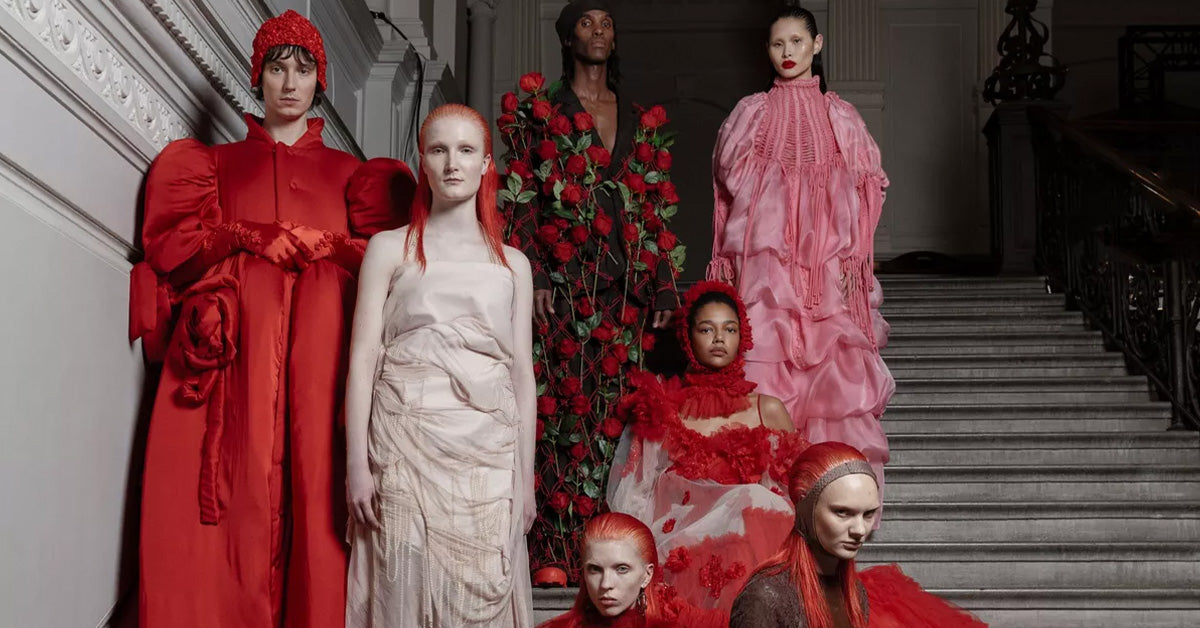
Last Thursday, the queues snaking outside Helsinki’s Ateneum Art Museum were not for a blockbuster impressionist retrospective, but for a radical restructuring of national identity. In what is being hailed as "Finland’s Met Gala," the nation’s premier art institution opened its doors to thirty of the country’s most avant-garde fashion designers, staging a takeover that was less about champagne-fueled exclusivity and more about existential survival. This was not merely a runway show; it was a deliberate, curatorial act of defiance against an industry crisis that has seen Finnish talent flee and brands shutter. By placing high fashion in direct dialogue with the museum’s Gallen-Kallela, Klimt & Wien exhibition, curators didn’t just display clothes—they executed a strategic pivot, reframing Finnish fashion from a struggling commercial commodity into a protected, export-grade cultural artifact.

The Pivot: From Commercial Crisis to Institutional Art
For decades, the narrative of Finnish design has been dominated by functionalism—the clean lines of Aalto architecture, the pragmatic prints of Marimekko, and the durability of industrial design. However, the scene on the ground has told a different, more fracturing story. As detailed in recent industry intelligence, the domestic fashion sector has been operating in "survival mode."
Talent emigration has become chronic. Independent labels have faced a brutal economic climate, forcing closures and stifling innovation. The Ateneum Gala emerged last week not as a celebration of excess, but as a counter-offensive to this decline.
By hosting the event within the hallowed halls of the Ateneum—Finland’s oldest and most prestigious art museum—organizers bypassed the traditional commercial gatekeepers. There were no buyers in the front row scribbling orders; there were no price tags. Instead, thousands of members of the public flooded the neo-Renaissance venue for free, daytime presentations.
This democratization serves a dual purpose. First, it proves to the state that fashion commands a massive, engaged audience (political capital). Second, it elevates the "wearer" to the status of a patron of the arts, rather than just a consumer. It is a sophisticated attempt to rewrite the ontology of Finnish clothing: these are no longer products to be sold at a discount; they are carriers of culture, worthy of preservation.

The Vienna Connection: A Curatorial Masterstroke
The timing of the gala was surgically precise. It ran in tandem with the museum’s exploration of the Vienna Secession, a movement defined by its rebellion against the stifling conservatism of the Austrian Academy. The exhibition highlights how Secessionist artists sought to liberate women from the physical tyranny of Victorian corsets, ushering in an era of fluid, expressive silhouettes.
Curator Minttu Vesala leveraged this historical weight to legitimize contemporary designers. Just as Klimt and his cohorts freed the body, modern Finnish designers are seeking liberation from the "corset" of commercial viability. The dialogue between the artifacts was literal and profound.
Designers like Tuuli-Tytti Koivula presented sculptural red gowns that seemed to bleed into the gallery space, acting as visceral responses to the Secessionist art on the walls. Kirsi Kokkonen, utilizing deep black velvet, showcased garments that she described as "carriers of memory, symbolism, and emotion."
This thematic alignment does the heavy lifting for the critics. It forces the viewer to assess the fashion on the same critical plane as a Gustav Klimt painting. It is an argument made through aesthetics: if the Secessionists are art, then so is this.

Industry Reaction: "Survival Mode" as a Rallying Cry
The emotional resonance of the event was palpable among the participants. The glitz of the "Gala" moniker belied the grit required to get there. Lähderinne, the recent recipient of the Young Designer of the Year award, provided the week’s most sobering quote, noting that the industry is currently "operating in a kind of survival mode."
This admission of vulnerability is rare in the fashion world, which usually operates on a facade of effortless success. By stripping away the pretense, the participating designers transformed the gala into a collective plea for investment.
"I wish that Finnish fashion would be seen not as an expense but as an export," Lähderinne stated. This is the crux of the new strategy. The event posits that fashion is a national asset, akin to the tech sector or the forestry industry, but it requires the initial capital injection that the arts receive.
Minttu Vesala, the architect of this strategy, emphasized that the goal was to show consumers that fashion is "a medium for storytelling and self-expression." While this sounds like standard PR rhetoric, in the context of a museum takeover, it reads as a mission statement for a new era of Finnish design—one that values narrative over utility.

The "Free Form" Strategy: Sustaining the Narrative
One-night galas are notorious for their ephemeral nature. They generate a spike in social media impressions that evaporates by the next morning. The Ateneum organizers, anticipating this, have structured the event as the launchpad for a sustained campaign.
Following the gala, the museum opened the "Free Form" exhibition on its third-floor landing. This installation will run through February 1, 2026, featuring a rotating roster of the 30 designers, ten at a time. This structural decision is brilliant in its pragmatism.
It ensures that the "fashion as art" narrative remains physically present in the institution for three months. It allows for repeated media visits and gives international press—like the editors at Vogue Scandinavia who covered the launch—a reason to return. It transforms a "moment" into a "season."
Furthermore, the rotating nature of the exhibit keeps the momentum alive. Just as interest might wane, a new cohort of ten designers is installed, refreshing the visual content and reigniting the conversation. It is a drip-feed strategy designed to wear down resistance to the idea of high fashion as high art.
Strategic Timeline: The Arc of Reinvention
- The Crisis Era (Pre-Nov 2025): Characterized by brand closures, a lack of domestic investment, and a talent drain to Paris, London, and Milan. The narrative is one of "survival."
- The Intervention (Nov 27, 2025): The Ateneum Gala executes a high-visibility institutional takeover. 30 designers are canonized as artists. Public engagement is proven via massive queues.
- The Sustained Campaign (Dec 2025 – Feb 2026): The "Free Form" exhibition maintains the physical presence of fashion within the museum. The rotation of designers keeps media engagement active.
- The Export Phase (Spring 2026+): The goal shifts to converting this cultural capital into financial capital. Success will be measured by international wholesale orders and government grant allocations.
Hidden Implications: What the Data Doesn't Show
While the visual data—the clothes, the crowds, the venue—is striking, the absences in the reporting are equally telling. Currently, there is no disclosed data regarding commercial conversion. Did the thousands of attendees buy anything? Is there a "shop the runway" mechanism?
The absence of this data suggests that the immediate goal is brand equity, not revenue. This is a "loss leader" strategy on a national scale. The organizers are betting that by inflating the perceived value of Finnish design through museum association, the commercial value will eventually catch up.
Additionally, the diversity of the casting and the designers remains a "black box." While the rhetoric emphasizes inclusivity ("the wearer is just as important as the outfit"), the specifics of who was represented—both on the runway and in the design studios—are currently opaque. For this movement to have true longevity, it must prove that it represents the changing face of Finland, not just its traditional artistic elite.

Future Forecast: The Rise of "Sartorial Diplomacy"
Looking ahead to 2026, the Ateneum Gala is likely the first signal of a broader shift in Nordic cultural policy. We are witnessing the birth of "Sartorial Diplomacy," where the government utilizes avant-garde fashion to modernize the country's image abroad.
If this pilot program succeeds, expect to see the "Free Form" exhibition tour. It is tailor-made for export to cultural institutes in London, New York, and Tokyo. The narrative of "The Viennese Secession meets Nordic Rebellion" is an easy sell to international curators.
However, the danger lies in the disconnect between the museum and the market. If the buzz from the Ateneum does not translate into production grants or wholesale orders, the "survival mode" will continue, merely dressed in finer clothes. The coming months are critical. The designers have done their part; now, the investors and policymakers must answer the call.
Written by Ara Ohanian for FAZ Fashion — fashion intelligence for the modern reader.