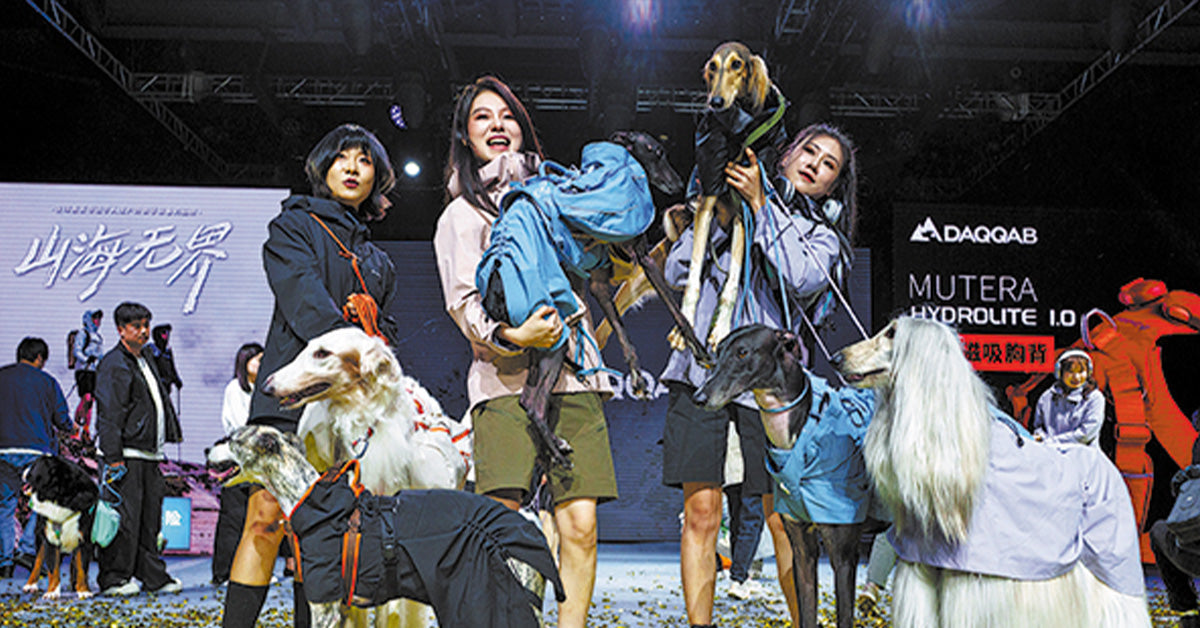
The runway at the 5th Shanghai Petjoy Fashion Week, which concluded in early November 2025, offered something far more significant than the spectacle of a Golden Retriever in a brocade coat. It signaled a profound sociological inflection point in the world’s second-largest economy. As Da Huang, the canine star of the hit drama Mysterious Lotus Casebook, strutted down the catwalk draped in ancient-style black fur, the message was unmistakable: China’s pet economy has transcended mere functional care to become a sophisticated theater of identity, nationalism, and emotional projection. This is no longer just about keeping animals warm; it is the industrialization of companionship, a sector now valued at a staggering 701.3 billion yuan ($96.6 billion), where pets have replaced progeny as the primary recipients of disposable luxury income. What we witnessed in Shanghai was the "emotional co-creation" of a new consumer class, one that is rapidly redefining the boundaries between human aspiration and animal existence.

The Commodification of "Emotional Co-Creation"
To understand the gravity of what transpired at the Shanghai Fashion Center, one must look past the novelty of the garments and into the psychology of the consumer. Zhang Xin, the Director of Petjoy Fashion Week, provided the event’s defining thesis, stating, "We are witnessing an industry evolution from functional satisfaction to emotional co-creation."
This phrasing is not accidental corporate speak; it is a precise diagnostic of a demographic crisis turned economic opportunity. With China’s birth rates at historic lows, the emotional labor and capital previously reserved for child-rearing is being wholesale transferred to pet ownership. The data corroborates this shift: the 25-to-34-year-old demographic now comprises 61.7% of the market. These are digital natives, often urban professionals, who are curating their pets’ lives with the same rigor and aesthetic consciousness one might apply to a human heir.
The runway shows reflected this anthropomorphic projection. The designs were not merely whimsical; they were deeply cultural. The trend of "Eastern Aesthetics"—integrating traditional Chinese motifs, the 24 Solar Terms, and Chang’an cultural symbols—dominated the presentation. This is a crucial pivot. By dressing pets in culturally loaded attire, owners are not just accessorizing an animal; they are performing a specific type of modern Chinese identity, blending heritage appreciation with contemporary hyper-consumption.
Nationalist Aesthetics vs. Global Giants
The commercial battleground revealed at Petjoy is distinct from Western markets. While Paris and Milan focus on heritage luxury houses launching pet lines, Shanghai is witnessing the rise of "Nationalist Luxury."
Petstar, a domestic leader in the space, has explicitly positioned itself as the aesthetic guardian of Chinese identity. Yu Xiaochun, the brand’s manager, declared an intention to "take Chinese red and build a pet brand with distinctive Chinese characteristics." This is a geopolitical maneuver as much as a branding strategy. By claiming the color red—a hue saturated with nationalistic and cultural significance—Petstar is positioning consumption of its products as a patriotic act, a soft-power push to reclaim the luxury narrative from Western hegemony.
However, the international heavyweights are not ceding the territory. The entry of Reebok Pet into the Chinese market this November, with a line of sports-focused jerseys and windproof jackets, highlights the friction between functional Western sportswear and decorative Eastern couture. Reebok’s strategy relies on a "dual justification" narrative: framing fashion as a medical necessity for cold-sensitive breeds while appealing to the owner's desire for an active, outdoor lifestyle. The clash between these two philosophies—Petstar’s cultural repatriation vs. Reebok’s functional athleticism—will define the next fiscal quarter of this near-trillion-yuan industry.
The Industrialization of Adorability
The velocity at which these trends move from the runway to the retail shelf is unprecedented. Unlike the traditional six-month lag of human fashion cycles, the pet fashion sector in China operates on an accelerated "see now, buy now" model. The "Pet Travel" category alone has surged 33% year-on-year, driving demand for specialized gear that functions in the real world, not just on a catwalk.
We are seeing a massive mobilization of the supply chain. Brands are leveraging the country’s sophisticated manufacturing infrastructure to mass-produce "runway exclusive" looks within weeks. This efficiency is fueled by the e-commerce dominance of platforms like Taobao and JD.com, where the visual impact of a pet in a "Chang’an style" coat translates instantly into conversion rates.
Furthermore, the market is diversifying into complex sub-sectors. It is not just clothing; it is a lifestyle ecosystem. From the "buying frenzy" triggered by South Korean brand Tailhigh’s insect-proof clothing (utilizing microcapsule essential oil technology) to the debut of Highoof, a sub-brand of the century-old Shanghai Soap Co., the market is rewarding innovation. Highoof’s pivot from traditional human hygiene to premium pet care represents a broader trend of heritage revitalization—old companies finding new life by servicing the "fur babies" of the modern bourgeoisie.

The Silence on Sustainability and Ethics
Despite the glossy veneer of the Shanghai Fashion Center, a critical analysis of the event reveals glaring omissions in the narrative. The industry’s rapid expansion—projected to grow at a CAGR of 13.6% for clothing alone—raises urgent questions about environmental impact that no one in Shanghai seems willing to answer.
The research indicates a total absence of discourse regarding sustainable materials or ethical sourcing. The transition from niche artisanal items to mass-market production implies a heavy reliance on synthetic fibers and petroleum-based textiles, likely sourced from opaque supply chains. In a fashion ecosystem that is increasingly scrutinized for its carbon footprint, the pet sector appears to be operating with a "hall pass," protected by the inherent cuteness of its end users.
There is also the uncomfortable question of animal agency. The narrative of "emotional co-creation" conveniently glosses over the reality of the animals themselves. While Reebok argues that clothing is "necessary" for cold protection, the proliferation of complex, restrictive couture for runway presentations suggests a prioritization of human aesthetics over animal comfort. The presence of robotic dogs like the LOVOT on the periphery of these events serves as a dystopian foreshadowing: if live animals become too difficult to mold into the perfect fashion accessory, the market may eventually pivot to algorithmic companions that never shed, never bite, and never ruin the silhouette.
Timeline: The Acceleration of the Pet Economy
The compression of events in 2025 signals a market running hot. The existence of two potential "Petjoy" iterations in a single year suggests an industry racing to capture market share before consolidation sets in.
- 2015–2022: The Functional Era. The industry is established, dominated by international conglomerates (Mars, Purina) focusing on nutrition and veterinary care. Fashion is a fringe novelty.
- March 2025: The Signal. The 4th Petjoy Fashion Week (referenced in market data) sets the stage with 1 million+ dogs in attendance figures, projecting a 48.4 billion yuan product market.
- November 2025: The Cultural Pivot. The 5th Petjoy Fashion Week concludes. The narrative shifts from "care" to "culture." Petstar pushes nationalist branding; Reebok enters the fray. The "Eastern Aesthetic" becomes the dominant trend.
- December 1, 2025: The Mainstream Moment. Coordinated media blasts from China Daily and Asia News Network solidify the narrative, framing the event as a mature lifestyle phenomenon just in time for the pre-Spring Festival retail rush.
Forecast: The Next Phase of Domestication
Looking ahead to 2026 and beyond, the trajectory of China’s pet fashion industry points toward aggressive consolidation and technological integration. The 18.3% year-on-year growth rate is unsustainable in the long term; we are approaching a saturation point where volume will be replaced by value.
Expect to see the "Smart Wearable" category explode. The current focus on textiles will merge with the tech sector, resulting in GPS-embedded harnesses, health-monitoring vests, and AI-driven dietary tracking integrated into apparel. The "emotional co-creation" will become "data-driven co-creation."
Financially, the sector is ripe for M&A activity. Global luxury conglomerates like LVMH or Kering, currently facing headwinds in traditional sectors, will likely look to acquire top-tier Chinese pet brands to access this high-growth demographic. Petstar’s aggressive positioning suggests it is grooming itself for a public listing or a massive buyout.
Ultimately, Shanghai Petjoy Fashion Week proved that the pet economy is no longer a sideshow. It is a mirror reflecting the anxieties, aspirations, and economic power of modern China. When a dog walks down a runway in Shanghai wearing a coat that costs more than a factory worker’s weekly wage, it is not just a fashion statement—it is a declaration of a new world order.
Written by Ara Ohanian for FAZ Fashion — fashion intelligence for the modern reader.